WHAT IS A MODEL RELEASE? AND WHEN DO YOU REQUIRE MODEL RELEASE?
A model release is similar in context to a liability waiver, which is a legal release typically signed by the subject /model/person in the photograph granting permission to publish the photograph in one way or another.
The legal rights of the signatories in reference to the material is thereafter subject to the allowances and restrictions stated in the release, and possibly in exchange for compensation paid to the photographed.
No release is required for publication, as news of a photo taken of an identifiable person when the person is in a public place. In general, no release is required for publication of a photo taken of an identifiable person when the person is in a public space unless the use is for trade or direct commercial use, which is defined as promoting a product, service or idea.
NOTE: NO MODEL RELEASE IS REQUIRED FOR TAKING THE PHOTOGRAPH,
IF REQUIRED MODEL RELEASE IS REQUIRED FOR PUBLICATION OF PHOTOGRAPH
The photographer is typically not the publisher of the photograph, but usually licenses the photograph to someone else to publish. Also the need for model release pertains to public use of those photos. (I.E: – Publishing them, commercially or not). The act of taking a photo of someone in public setting without a model release, or of viewing or non-commercially showing such a photo in private, generally does not create legal exposure.
Photojournalists almost never need to obtain model releases for images they shoot for news or qualified editorial publications. Photographers who also publish images mayneed releases to protect themselves, but there is a distinction between making an image available for sale (even online), which is not considered publication in a form that would require a release, and the use of the same image to promote a product or service in a way that would require a release.
TYPES OF RELEASE
- ADULT RELEASE: This is the form most commonly referred to as a “model release”. The language of the release is normally intended for use by models over the age of majority.
- MINOR RELEASE: This variant of the model release contains language referring to the model (who is a minor) in the third-person, and requires signature by a parent/guardian of the model.
- GROUP RELEASE: This is a modified version of the adult release, which includes additional signature lines to accommodate use by multiple models or subjects in a single image.
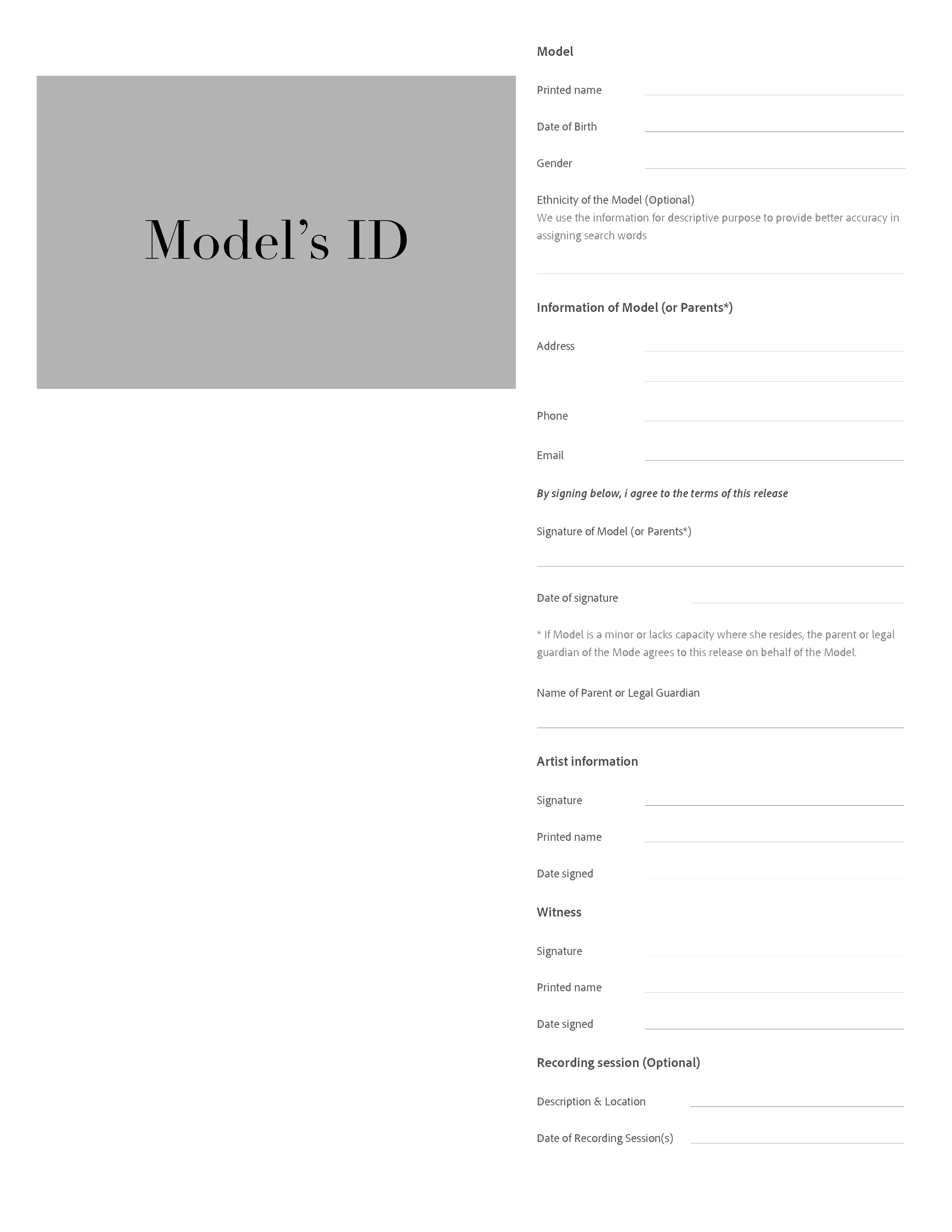
Ask yourself, would the person recognize him/her in my photo? If your answer is “YES”, then you need to include a model release with your submission. Recognition can be based on external factors (eg: other recognizable people, unique clothing, equipment, or location) or personal factors (eg: tattoos or birthmarks). That’s why it is always safer to get a model release. The model release must include a copy of the model’s PHOTO ID to verify that the model Is an adult.
You also need model releases for any illustrations or vector artwork based on real people or body parts. For example, you need a model release for a photograph that includes a face printed on a t-shirt or a photo portrait on a wall. Finally, don’t forget to include a model release for self-portraits. In this case, you must sign the model release as both the photographer and the model.
Be aware of the following requirements:
- · To assure legibility, print all names in CAPITAL LETTERS
- Companies and agencies have the right to use different photographers. If you are submitting content as a company, your company name must appear next to the photographer name.
- If the model is under 18 years of age, you must obtain the signature of the parent/legal guardian. Try to get both parents to sign the release—one as the parent or legal guardian and the other as the witness.
- If you are a parent photographing your child, you must print your name and sign twice: once as the photographer and once as the parent.
- While capturing a group, you need the names and signatures of each person on a separate release. For example, if you photograph company’s executives, you need to have the model release from each and every person separately, one cannot sign the release on the behalf of the whole group.
- All signatures must be dated and the dates must match.
- The moderators cannot accept a release that appears stitched together digitally.
- Model Releases must be submitted as JPEGs and titles must be fewer than 30 characters long.
Sources for release forms include:
- Alamy
- American Society of Media Photographers’ model, minor and property language and the ASMP Release app
- Fotolia model, minor, and property releases
- Getty Images and iStockphoto
- iD Release app
- Shutterstock
- Top Model Release app
 Site Title